The same way, every year
Birthday traditions for kids that start at one and grow with them
A birthday tradition is anything your family does the same way every year, and the sameness is the point. Most lists hand you thirty ideas. This one gives you a few that leave something to keep, says which you can start at the very first birthday and how each changes as your child grows, and shows how to keep every year's record side by side so the years can be compared.
What turns a habit into a tradition
Psychologists who study families draw a useful line here. In a 2002 review of fifty years of research on family routines and rituals (Journal of Family Psychology), Barbara Fiese and her colleagues described a routine as saying "this is what needs to be done," and a ritual as saying "this is who we are." Birthdays were among the rituals the studies identified most often, along with holidays and Sunday dinners.
So a tradition doesn't need to be big. Pancakes on the birthday morning become a tradition the second year you make them and call them birthday pancakes. What matters is that your child can count on it, and that you can still manage it in a hard year: the year of the new baby, the move, or the flu that cancelled the party. Choose traditions that are cheap to repeat. Anything that needs a sitter, a booking or a good week is easy to skip, and once a tradition skips a year, it is easy for it to skip the next.
Start with two: one to do, one to keep
Birthday traditions come in two kinds. Some are about the day: the breakfast, the decorated door, the song. Your child enjoys them in the moment and remembers them as a feeling. Others leave something behind: a letter, a photo, the answers to the same questions. Those are what your grown child will be able to hold.
Start with one of each. Two traditions you keep every year are worth more than eight you tried once. You can add more later, and adding is easier than dropping one a child has come to expect.
Traditions that leave something to keep
These repeat well, cost little, and get better with every year you add.
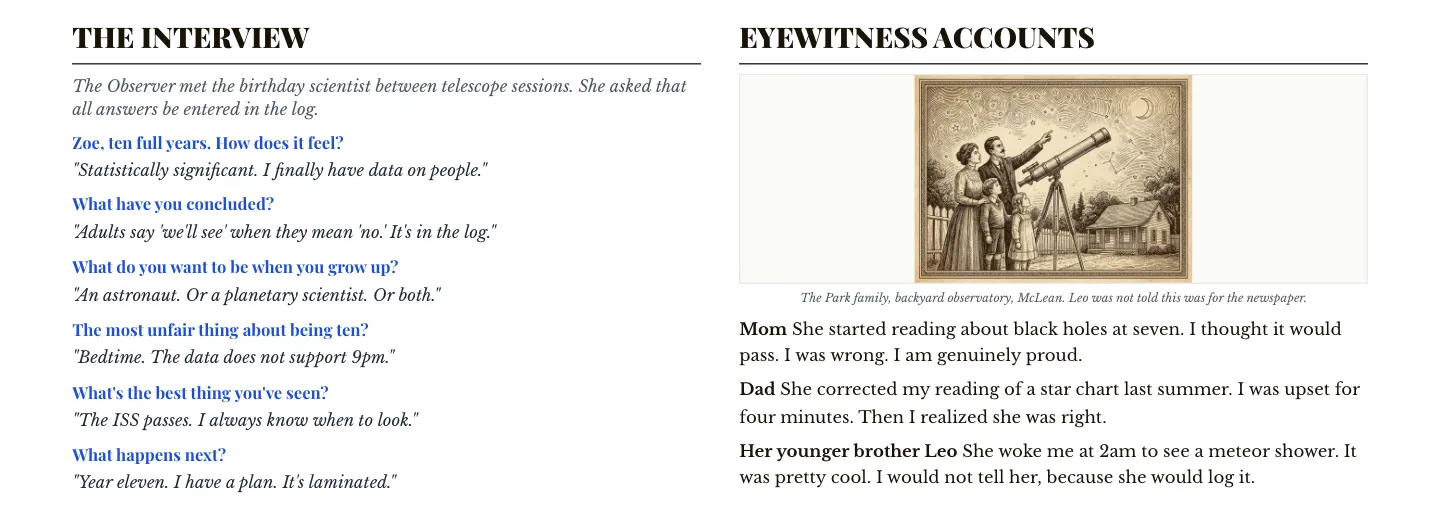
- The birthday interview: the same short list of questions every year, with the answers written down exactly as they come. Our birthday interview questions has a list to repeat, a free sheet to print, and separate lists by age, starting with an interview you fill in for a one-year-old.
- The birthday letter. Write to them the night before, about this year in detail, and keep every letter in one folder. Some families hand over the stack at eighteen; others read last year's aloud each birthday.
- The same photo. At the first birthday, pick a spot, a chair or a stuffed animal, and take the same picture every year. The animal stays the same size, and your child doesn't.
- The height mark, on a board or strip you can take with you if you move, with the date beside each line.
- The hand, then the drawing, then the name: a handprint at one and two, a self-portrait from about four, and their name in their own handwriting once they can write it.
- A book, inscribed. One book each birthday, with the date and a sentence about them written inside the front cover.
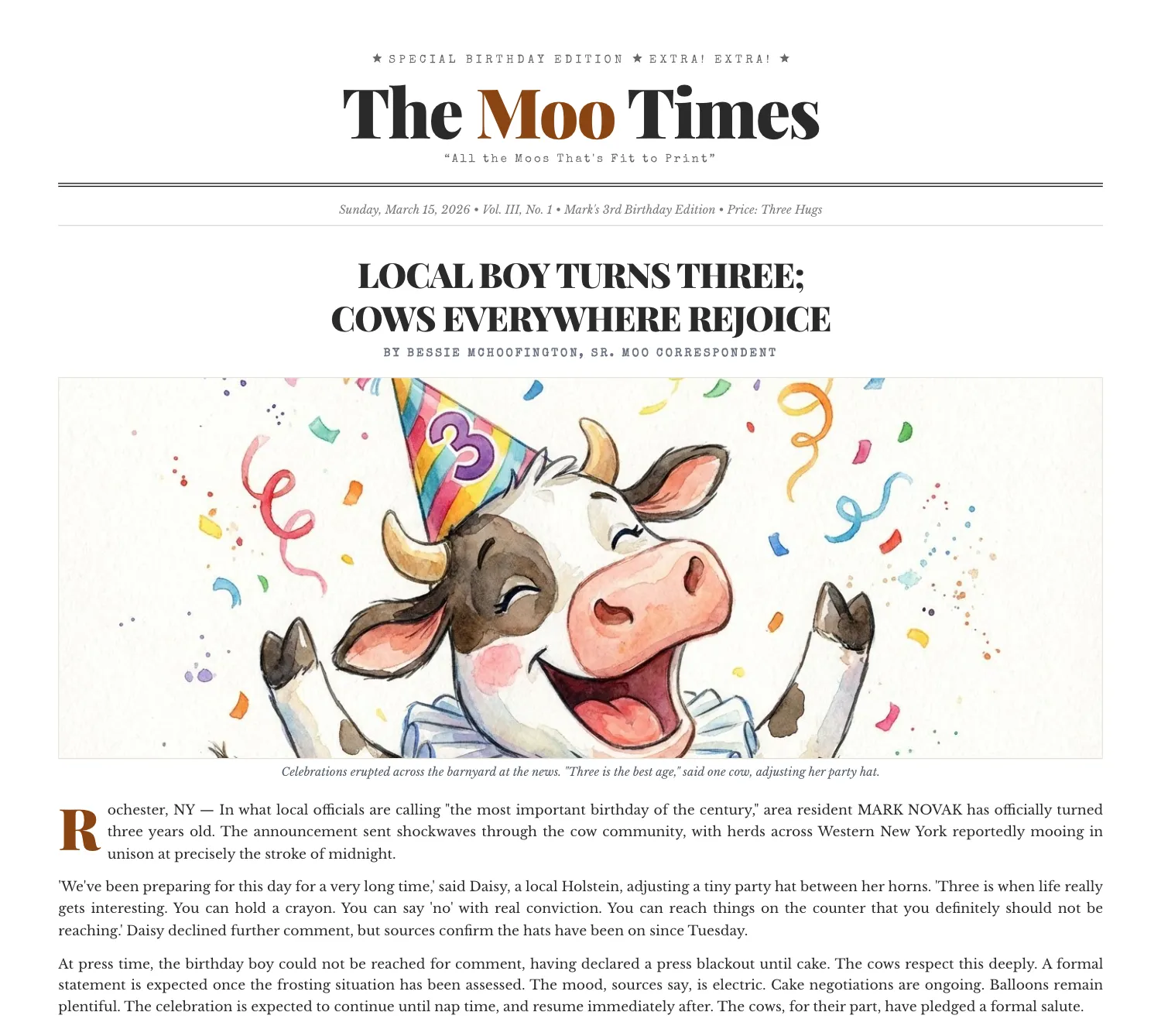
- A birthday newspaper: a front page about who they are at this age, with what they love, what they said and who is in their life. Make your own, or have one written for you (more on that below).
Keep every year side by side
Yearly keepsakes have a way of scattering: a letter in a drawer, the interview in a phone's notes, the photo lost among thousands of others. A tradition shows what it is worth when the years sit next to each other, so give them one home from the start.
One way to do it is a box or a binder with one folder per year, filled in the same order every time. On each birthday morning, before anything else, take out last year's folder. If your child is old enough to follow along, read them what they said a year ago; it gives you both a running start on this year's questions. In each folder, keep:
- The photo, printed, with the date and their age on the back.
- The interview sheet, or a printout of the answers.
- The letter, sealed or not, as you prefer.
- The handprint, the drawing or the signature.
- The paper, if you make one, folded once.
- One line on the front of the folder: their age, and the thing everyone will remember about that year.
How each tradition changes with age
The keeping traditions work at every age, but what goes in the folder changes as your child does. By six, you have six folders, and a child can lay them out on the floor in a row and watch themselves grow up. A rough guide to what each year holds:
| Tradition | At 1 | At 2 | At 3 and 4 | At 5, 6 and up |
|---|---|---|---|---|
| Interview | You answer for them: what they do, the sounds they make | A word, a point or a show-me | Real answers, often wrong and all worth keeping | Longer answers, and they start interviewing you back |
| Letter | From you, about this year | From you, quoting their new words | From you, with a scribble from them at the bottom | From you, with a line they write themselves |
| Photo | Same spot, same toy | Same spot, if they hold still | They choose the pose | They choose the pose and check the picture |
| Hand or drawing | A handprint | A handprint beside last year's | A drawing, then a self-portrait | Their name in their own writing |
| Paper | Jokes about what they do | Jokes about their first words | Jokes built on their opinions | Their expertise, taken seriously |
Birthday traditions to start with a baby
A baby can't take part in a tradition, so the first birthday's traditions are the ones you do on their behalf. That makes the first year the easiest one to start: nobody has to cooperate, and nothing has to be explained. Begin these at one, and every later year simply repeats them:
- The first letter, written the week of the birthday, about who they are at twelve months.
- The first of the same photos, in a spot you will still have next year.
- A handprint on a sheet you can keep flat in the folder.
- An interview you answer for them. Our first birthday interview lists sixteen things to watch for and write down, with a free sheet to print.
- The first folder, labeled with their name and the date.
Which first birthday ideas are one-offs
Some first-birthday things happen once, and that is fine: the smash cake, the party theme, a time capsule sealed until eighteen (our time capsule guide covers that one). Enjoy them at one, and save the repeating for things that can grow with your child.
For more ways to keep the first year, see our first birthday keepsake ideas. At two, the year talking arrives, our second birthday keepsake ideas cover how to save their words before they change. At three, our third birthday keepsake ideas take over, and by then your child can answer the interview questions themselves.
Traditions for the day itself
These are the traditions children feel. Keep them simple enough to manage on a school day, since birthdays land on weekdays too.
- A birthday breakfast they choose, from the year they can choose. Until then, you pick it and call it their birthday breakfast.
- The door, the chair or the bedroom decorated after they fall asleep, so it's the first thing they see in the morning.
- The same song at the same moment: when they wake up, or when the candles are lit.
- The story of the day they were born, told at bedtime, with a little more of it each year.
- A birthday walk to the same place, ending in the same photo.
- One choice that is theirs alone: dinner, the movie or the park.
Starting late, or missing a year
If your child is already four, start this year. That still leaves more than a dozen birthdays before they leave home. You can make a page for the years you missed from photos and old videos, and write down what you remember while you still can.
If you miss a year, do it a week or a month late, and write the real date on it. A late interview is still an interview, and next year you pick the tradition back up. With a second child, keep the same traditions and the same questions, and give each child a box of their own. Later on, they can compare what each of them said at the same age.
A birthday newspaper every year
A birthday newspaper suits a tradition because it reads like the year it was made. Line up the papers from one, two and three, and the jokes move from what they did to what they said to what they think about everything.
You can make one yourself from a template, and our birthday newspaper ideas list thirty things to put in it. Or Tiny Times can write it. You tell us about your child, AI writes the stories and makes the illustrations, and you read a free preview before paying anything. The keepsake edition is $19.99 for each paper: it unlocks every illustration, text editing and a printable PDF, which you print at home or at a local shop. We don't ship printed copies. Read each year's paper for names and facts before you print it, since AI can add a flourish that never happened.
Common questions
What are good birthday traditions for kids?
Ones you can repeat every year without much effort. A yearly interview, a letter, the same photo in the same spot, a height mark and a birthday newspaper all leave something to keep. A chosen breakfast, a decorated door and the same song make the day feel like theirs.
What birthday traditions can you start with a baby?
The ones you do for them: a letter about who they are at twelve months, the first of a yearly photo in the same spot, a handprint, and an interview you answer on their behalf. Keep each year's together in one folder.
How do you keep a birthday tradition going?
Keep it small enough to manage in a hard year, do it at the same point in the birthday each time, and keep every year's results in one place. If you miss a year, do it late and write the real date on it.
How much does a yearly birthday newspaper cost?
Making your own from a template costs only the printing. With Tiny Times, each year's paper has a free preview and costs $19.99 to keep as a printable PDF, which you print yourself.