Keeping age two
2nd birthday keepsake ideas that save age two before it turns into three
After the first birthday, the keepsakes tend to stop, and two is the first birthday that slips by with a party and not much else. That is a shame, because your two-year-old is starting to talk, in words nobody else says quite the same way, and by three most of those versions will be gone. Here is what is worth saving at two, the keepsakes that save it, and a plan to get it done before the third birthday.
Why age two is worth its own keepsake
The first birthday gets the footprints, the letter and a box with the candle in it. By the second, the novelty has worn off, there may be a new baby or a new job, and the party is the whole plan. Yet the year between two and three is the one in which most children start talking in short sentences.
The CDC's milestone checklist for age two lists putting two words together, like "More milk," and pointing to things in a book when you ask. By two and a half it lists about 50 words, two-word phrases with an action in them, like "Doggie run," and words like "I" and "me." Children get there at their own pace, so treat the checklist as a guide and never as a schedule. What it does show is that this is the year talking arrives, and that the way your child talks this month won't last. "Nana" turns into banana. The name they gave their sister gets corrected by a well-meaning grown-up. Write it down while it is still true.
What a two-year-old is like that is worth saving
Before you pick a keepsake, list what you would miss. Most of it is small, and almost none of it shows up in a photo. Look for these:
- Their words, written the way they say them: "bah" for ball, "Dee" for a sister called Delia, "nana" for banana.
- Their first sentences, which are usually two words long and very sure of themselves: "Bye bye truck." "Me do it."
- The noes. How they say it, how often, and what they refuse with total conviction, such as a particular cup or any sock with a seam.
- The rituals they insist on: the same book three times, the order the stuffed animals go to bed, the exact words of goodnight.
- What they call the people in their life, including you.
- The current obsession at full strength: the garbage truck on collection day, the moon, the ceiling fan.
- What scares them this year: the vacuum, the hand dryer, a goat at the petting zoo. Next year it will be something else.
- How they move: the run with the arms held straight back, the dance that is mostly knees.
- Their first pretend play. The CDC's checklist for two and a half gives the example of feeding a block to a doll. Note what yours pretends, and who gets fed.
Keepsakes that save their words
Words are the part of two that disappears fastest, so start with them. All of these are free, and none needs the child to sit still for long.
- A word list. Start it on the birthday with every word they say, spelled their way, and add new ones with the date as they come. Tape it inside a kitchen cupboard door so it is always within reach. By three it will be long, and the first entries will make you laugh.
- Their own dictionary, in two columns: what they say, and what it means. "Bah: ball, or anything round." "Uh-oh: I have dropped this on purpose." It takes a few minutes and reads better every year.
- A two-minute recording. Sit somewhere quiet, hold up a few things they know, and ask what each one is. Ask them to sing. Record it on your phone and copy it to an album you will still have in ten years. At two and a half, do it again with the same things and the same song.
- A birthday interview with one-word answers. Our birthday interview questions for a 2-year-old are built for a word, a point or a show-me, with a free sheet to print. If you did a first birthday interview last year, keep the two sheets together.
- A letter that quotes them. Write to them at two, and put their actual words in it. Twenty years from now, a line like "you said 'me do it' about everything, including things you could not do" will bring back this year faster than anything else in the box.
Keepsakes that save how they are right now
These are the classics, and at two each one is best kept right next to last year's.
- A handprint or footprint beside last year's, on the same kind of paper. If you made one for the first birthday, the change between the two is the whole keepsake. A two-year-old needs a quick hand and a distraction, so have a wipe ready before the ink comes out.
- The same photo, a year on: the same spot, the same chair, the same stuffed animal as at one. At two they will probably be holding the animal upside down and halfway out of the frame. Keep that one.
- A height mark with the date, on a board or strip that can move house with you.
- Their first scribbles, dated, with what they told you it was written on the back. At two, the answer may be one word or a sound effect.
- A photo of the thing they can't be without, the blanket or the bear, while it still has both eyes.
- The shoes they learned to run in, scuffed toes and all, with a label inside saying when they wore them.
A plan to save it before three
None of this has to happen on the birthday itself. Spread across the year, it suits a two-year-old's attention, and it never turns into a project. One way to pace it:
- On or near the birthday: the handprint, the same photo as last year, and the first page of the word list.
- In the first week: the interview and the recording, a few questions at a time, during a bath or a snack.
- On the first of every month: add the new words to the list, with the date. A few minutes is enough.
- At two and a half: record again with the same objects and the same song, then play the two recordings back to back.
- A month before three: write the letter, close the word list, and put everything in one labeled envelope or box.
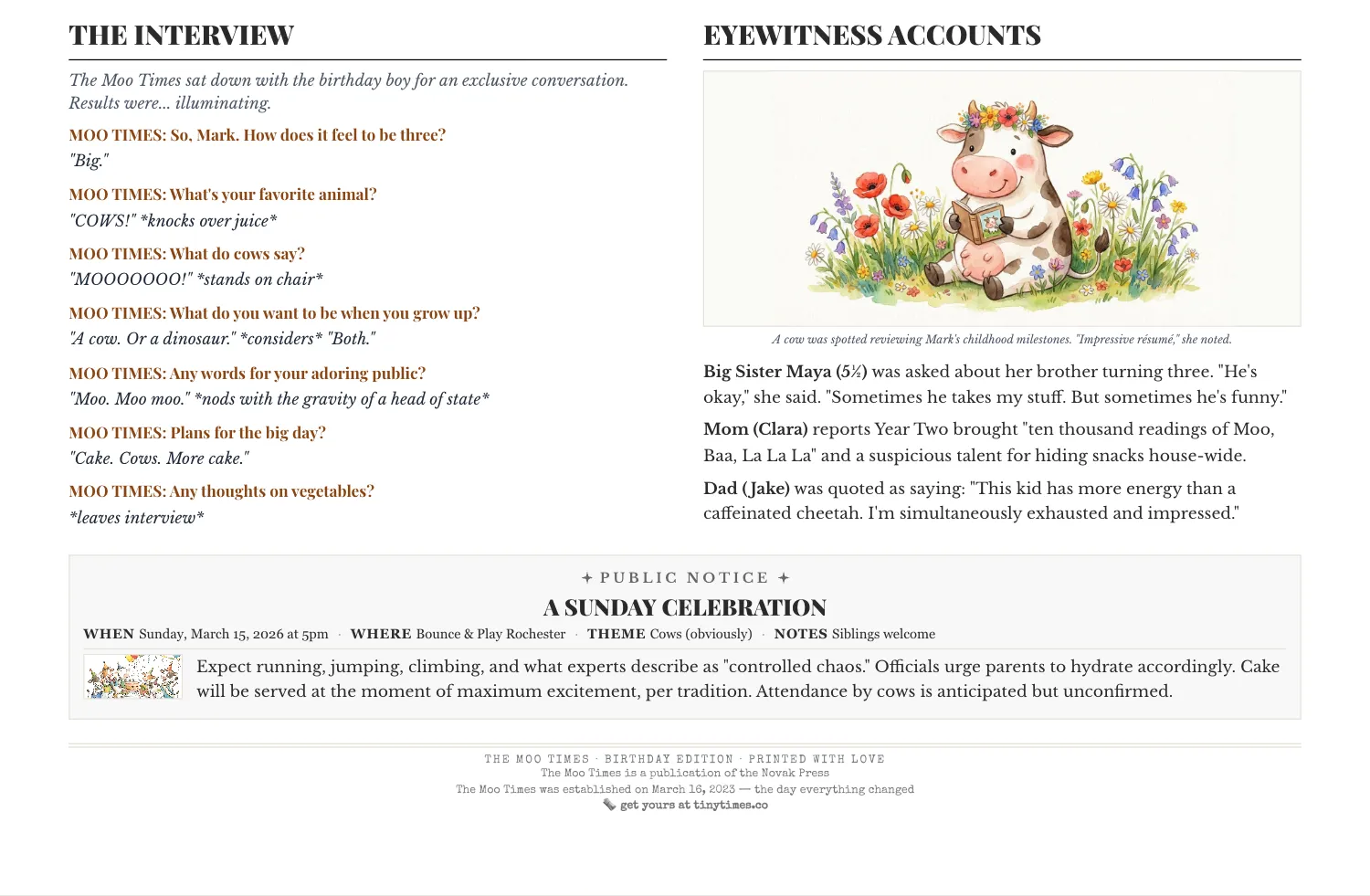
What a birthday newspaper looks like at two
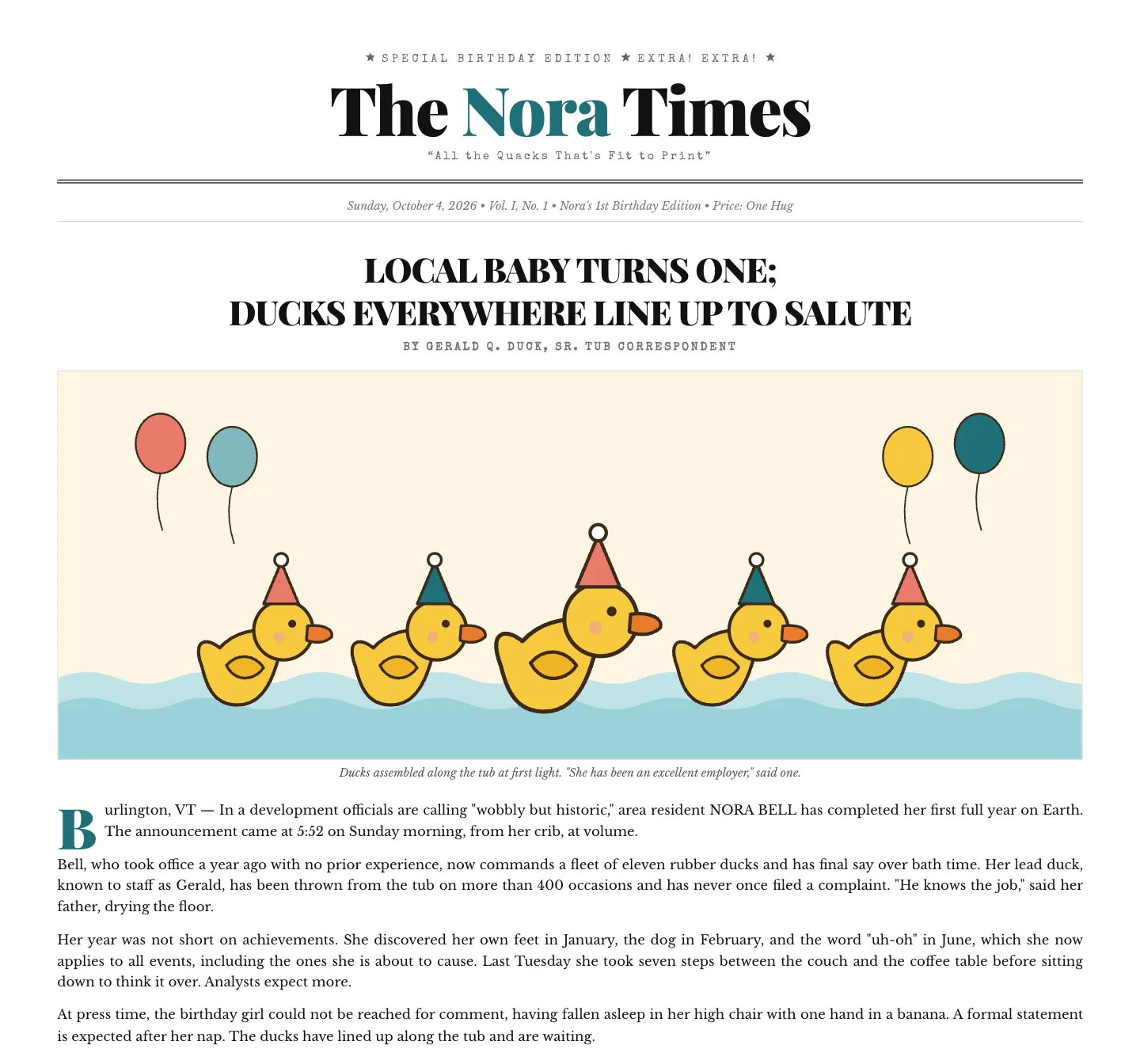
A birthday newspaper turns those details into a joke front page: a grave headline about the garbage truck, and an interview with someone who answers "Truck!" to every question. We don't have a sample paper for age two. The Nora Times, below, is a first birthday sample we wrote by hand for an invented family, and The Moo Times is our sample for a three-year-old. A paper for a two-year-old sits between them, with the same sections.
In a paper you make with Tiny Times, AI writes the stories and makes the illustrations from what you share. Type a real line into "Something they said" on the form and the paper quotes it as written. Beyond that, AI is told to keep a two-year-old's own lines to a word or two, and not to invent a first word, a pet or a milestone you didn't give it. It is AI, so it can slip; read the interview closely in the free preview. If it sounds like them, $19.99 unlocks every illustration, text editing and a printable PDF, which you print at home or at a local shop. We don't ship printed copies.
If you only do one
Keep the word list. It costs nothing, takes a few minutes a month, and nothing else on this page will be as hard to remember later. Label whatever you make with their name, the date and how old they were, and keep it all together, in the first birthday's box if there is one.
Then start again at three. Our third birthday keepsake ideas pick up where this leaves off, when a child can answer real questions and has opinions about everything. If you would like some of this to come back every year, our guide to birthday traditions for kids covers which keepsakes repeat well and how to keep each year's side by side.
Common questions
What is a good keepsake for a 2nd birthday?
One that saves their words, since two is the year talking arrives: a dated word list, a short recording, a birthday interview with one-word answers, or a letter that quotes them. A handprint or photo next to last year's shows how much they grew.
How do I remember the things my 2-year-old says?
Write each new word down with the date, spelled the way they say it, on one list you keep somewhere easy to reach. Record two minutes of them talking on the birthday, and again at two and a half.
Can you make a birthday newspaper for a two-year-old?
Yes. Enter their age as two and give the form the words they really say. AI writes the paper and is told to keep the child's own lines to a word or two, and anything you type into "Something they said" is quoted as written. Read the free preview before you decide on the $19.99 PDF.
What should I write in a letter for my child's second birthday?
What they are like this month, in detail: the words they say and how they say them, what they insist on, what scares them, who they run to. Quote them. Then tell them what you hope for them, and date it.