Filling the front page
Birthday newspaper ideas: 30 things to put in your kid's paper
A good birthday newspaper is a small joke told with a straight face: your four-year-old's views on broccoli, reported with the gravity of a national election. Here are thirty ideas by section of the paper, with pages from our sample editions so you can see them working.
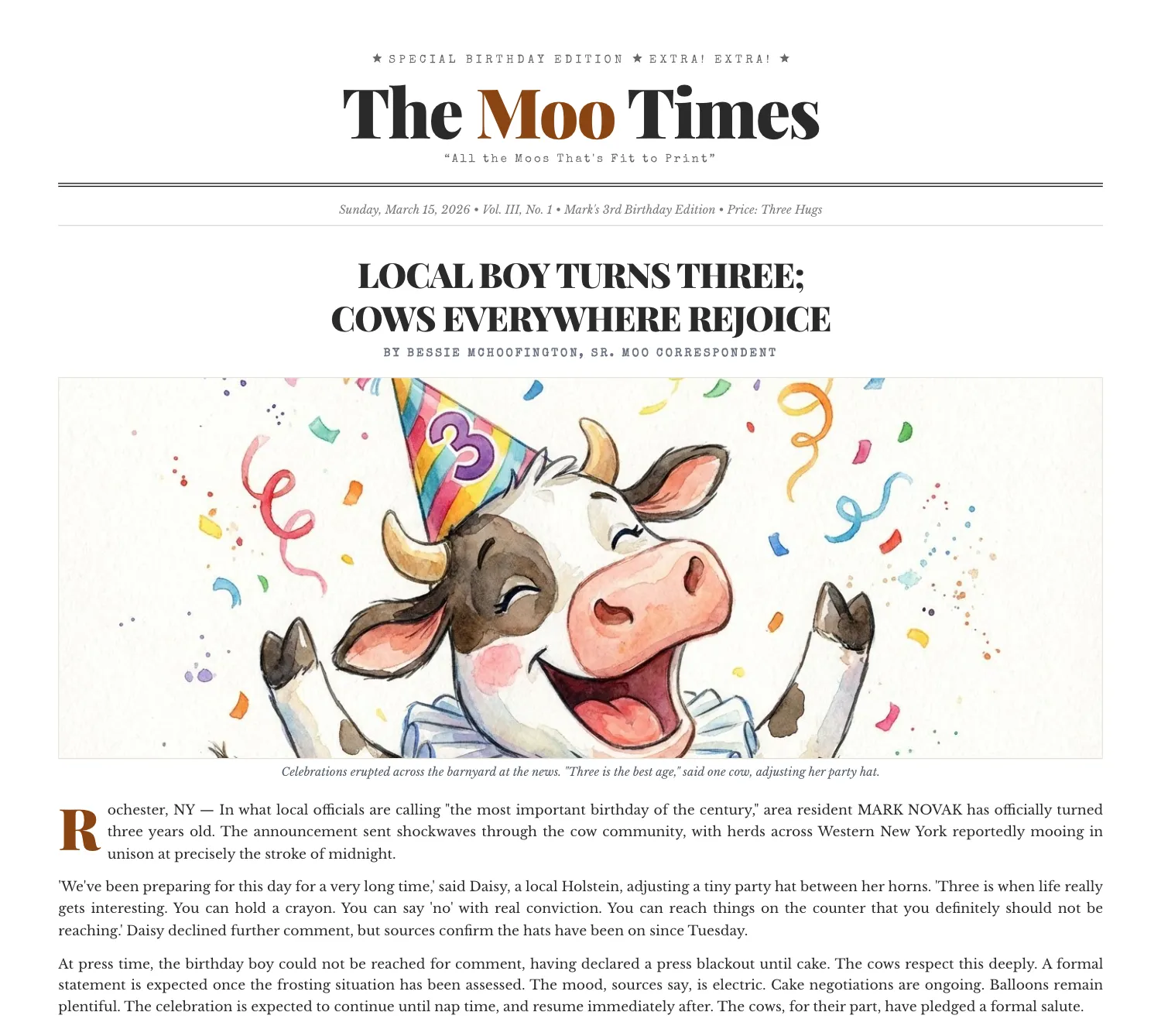
Headline ideas for the front page
The front page needs one big, serious headline about something small. Start with what your child is known for at home and write it the way a wire service would. These are patterns to borrow:
- The big news: "LOCAL BOY TURNS THREE; COWS EVERYWHERE REJOICE"
- The scandal: "SNACKS MISSING ACROSS HOUSEHOLD; TODDLER DECLINES TO COMMENT"
- The official record: "AREA GIRL READS SAME BOOK FOR 400TH TIME, CALLS IT 'STILL GOOD'"
- The negotiation: "BEDTIME TALKS COLLAPSE AFTER THIRD GLASS OF WATER"
- The announcement: "SIX-YEAR-OLD CONFIRMS SHE IS NOW 'BASICALLY A TEENAGER'"
- The expert claim: "LOCAL DINOSAUR AUTHORITY, 5, CORRECTS MUSEUM GUIDE"
Interview ideas
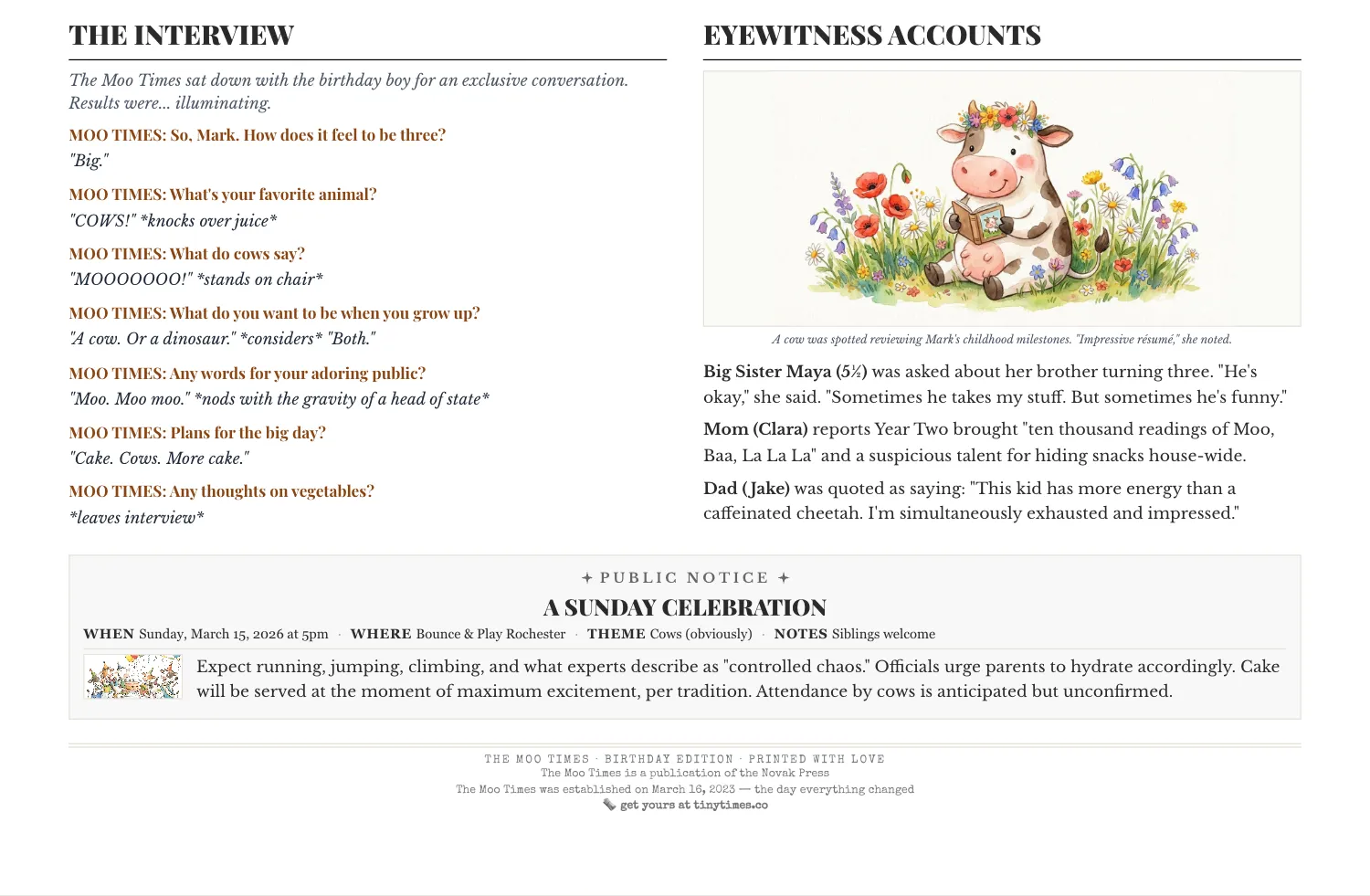
An interview is the section most likely to get read aloud. Ask your child real questions and write the answers down exactly as they come, with stage directions. The less useful the answer is, the better it reads. We keep birthday interview questions by age, each list with a free printable. To start, ask them:
- How does it feel to be this age?
- What is your job?
- What is the most important rule in this house?
- Who is the boss of the family, and why?
- What is your opinion on vegetables?
- What will you do when you are a grown-up, and how much will it pay?
Family and friend ideas
Newspapers quote people, so yours can too. Short quotes work best, and siblings give the most honest reviews. Get permission before you print anything a person might find embarrassing.
- A review from a big sister or brother: "He's okay. Sometimes he takes my stuff."
- A statement from a parent on the state of the household.
- A grandparent's eyewitness account of something the child did.
- A comment from the family pet, as given to reporters.
- A teacher or babysitter's official report.
- A letter to the editor from a best friend.
Ideas for the back pages
The back pages are where the small jokes go. These are quick to write, and they make the paper feel like a real paper.
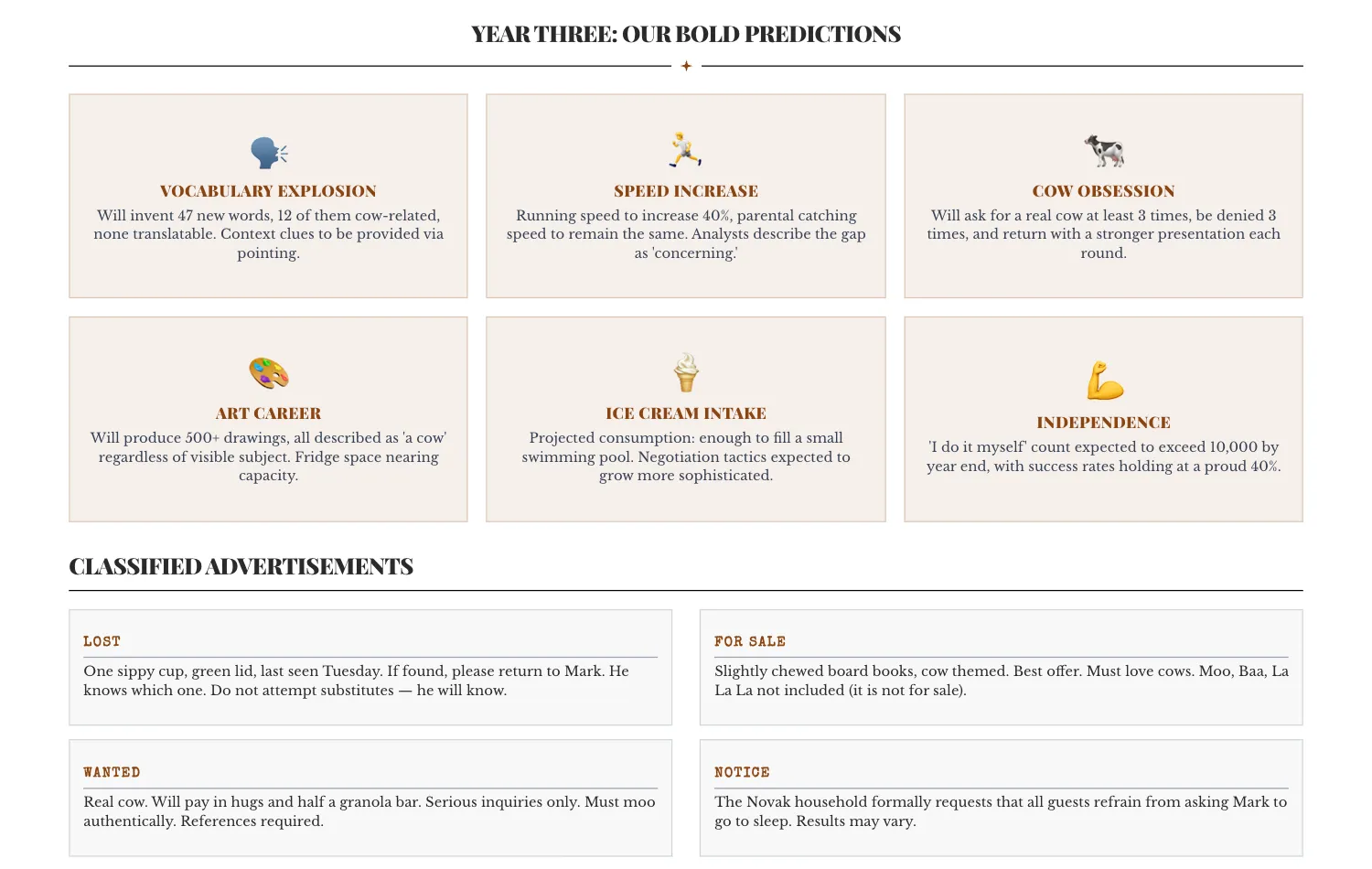
- Classified ads: LOST: one sippy cup. WANTED: a real cow. Each one makes a little joke about something true.
- Six bold predictions for the coming year, each based on something they actually do.
- A weather report for the household: "Morning tantrums clearing by lunch."
- A sports page covering their actual athletic achievements, such as stairs or couch climbing.
- Top-ten charts: the most-played song, the most-read book, the most-requested dinner.
- Fun facts about their favorite animal or vehicle, each with a joke back to them.
Ideas for the part they will keep it for
Close with something sincere. After a page of jokes, a sincere paragraph lands harder than it would anywhere else, and years from now it will be the part your child reads twice.
- An editorial, written as a letter to them from the "editorial board" (that's you).
- A timeline of the year: first time on a bike, first day of school, first big loss at a board game.
- A "this year in numbers" box: books read, band-aids applied, times they asked why.
- A list of the words they say wrong that you will miss when they get them right.
- A photograph or drawing of them, or a drawing by them, on the last page.
- A short note on what your family was doing and worrying about this year.
Change the paper with their age
At age one, every joke is about what the baby does, since they will not say much. The interview answers are babble and thrown socks. At age three, you have a wild supply of real quotes, and those should run almost unedited. At age seven, they have strong opinions and are starting to know it, so let them contribute. By age ten, the paper is funniest when it takes their expertise seriously, and they might want to edit it themselves.
Name the paper after their big interest, too: the sample papers we made include The Moo Times and The Unicorn Gazette. One reader-pleasing touch is a small price on the masthead, like "Price: One Hug."
How to put it all together
If you like writing and layout, you can build this yourself, and we compare your options honestly in our guide to birthday newspaper templates. Plan for a few hours.
If you would prefer to skip the writing, Tiny Times does that part. You give us the details in a few minutes, AI writes the stories and makes the illustrations, and a free preview shows all the text, watermarked, with some illustrations in grey and the rest held until you unlock. If it sounds like your child, $19.99 unlocks the full illustrations, text editing and a printable PDF. If it does not, you have spent nothing. Check every name and fact either way, since AI will sometimes add a flourish that did not actually happen.
Common questions
What should I put in a birthday newspaper?
A big front-page headline about something small, a lead story, an interview with the birthday kid, family quotes, predictions for the year, classified ads, and a sincere letter at the end.
How do I make a funny birthday newspaper headline?
Take something small your child really does and report it as though it were national news. For example, "BEDTIME TALKS COLLAPSE AFTER THIRD GLASS OF WATER." The funny part comes from the serious tone, so keep the wording plain.
How long should a birthday newspaper be?
Two to four pages is plenty for a young child. A Tiny Times paper is two 11 × 17-inch pages, which works out to a front page and a back page.