Your family, on the front page
How to make a personalized birthday newspaper for your child
A birthday newspaper tells the story of your child at this particular age: what they love, what they say, and the everyday moments your family wants to keep. Here is what goes in one, how to gather it, and how to check the result before it goes on the wall.
What a finished paper looks like
A complete edition has more in it than most people expect. A Tiny Times paper is two 11 × 17-inch pages: a front page with a big headline, a lead illustration and a story, then an interview, family quotes and a party notice. The back page carries fun facts, a milestone, six predictions, classified ads, and a letter to your child. You can read a whole one here, and here are the first and last parts of it.
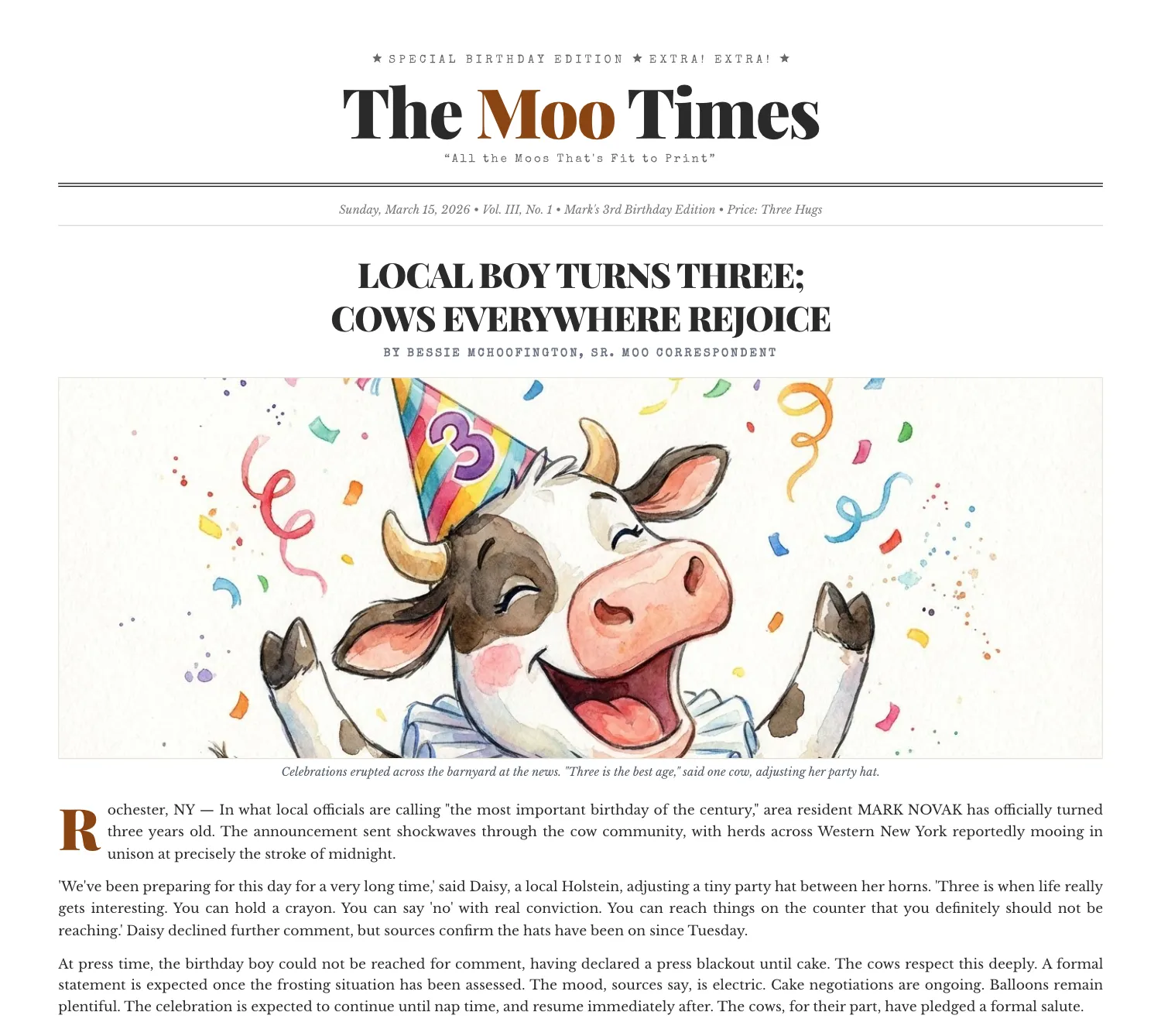
Give the front page a story
Choose one detail that makes your child immediately recognizable to the people who love them. It might be their certainty that every dog is a friend, a recent obsession with space, or the elaborate rules they have invented for bedtime.
The headline can be playful, while the story underneath carries the real memory. 'LOCAL CHILD LAUNCHES BEDTIME NEGOTIATIONS' could lead into their nightly request for exactly three books and one extra hug. This is an illustrative example; the best version comes from your own family. We have thirty more ideas to get you started.
Gather enough material for a small edition
A few concrete details are more useful than a long list of adjectives. Instead of only saying 'she is funny,' describe the moment that made you laugh. Instead of 'he loves animals,' name the animal and what he knows about it.
Ask relatives for a short memory if you would like their voices included. You can gather those messages yourself and use them as inspiration when filling out the form or editing the paid edition. Keep attributed quotes accurate and ask before sharing a personal story publicly.
- A favorite thing: the book, toy, song, or food they keep choosing.
- An interview: a question you asked and the answer only they would give.
- A milestone: something they tried, learned, or became brave enough to do.
- A family voice: a short quote or affectionate observation.
- A prediction: a playful idea about their next big adventure.
- A wish: one sentence on what you hope for them. This often shapes the letter at the end.
The steps, from form to keepsake
Here is what actually happens when you make one with Tiny Times, and what you can expect at each stage.
- Tell us about your child. Give their first name and age, choose their interests, add whatever details you like, and pick one of four styles: Heirloom, Editorial, Comic or Storybook. You don't need an account to preview.
- Wait a minute or two while AI writes the stories and starts on the illustrations.
- Read the free preview. It shows all the text, watermarked, with some illustrations in grey and the rest held until you unlock. If it doesn't sound like your child, you can walk away having paid nothing.
- If you like it, pay $19.99 to unlock text editing, remove the watermark and get the printable PDF. Tiny Times does not ship printed copies.
- Fix any details, download the PDF, and print it at home or at a local shop.
Check it before you print
The stories and illustrations are AI-generated from your details. That's what makes it fast, and it is also why you should read the result twice. Read it once for the feeling and once for the facts. Does it sound like your child? Are the names and relationships right? Did an invented flourish accidentally become a claim about something that really happened? Editing lets you bring the text back to your family's voice.
Some of the jokes are supposed to be invented. No one believes that a cow gave a statement to reporters. The ones to catch are the small plausible ones: a sibling's age that's off, a trip you never took, a quote a grandparent never said. Replace those with what really happened, since the true version is almost always better anyway.
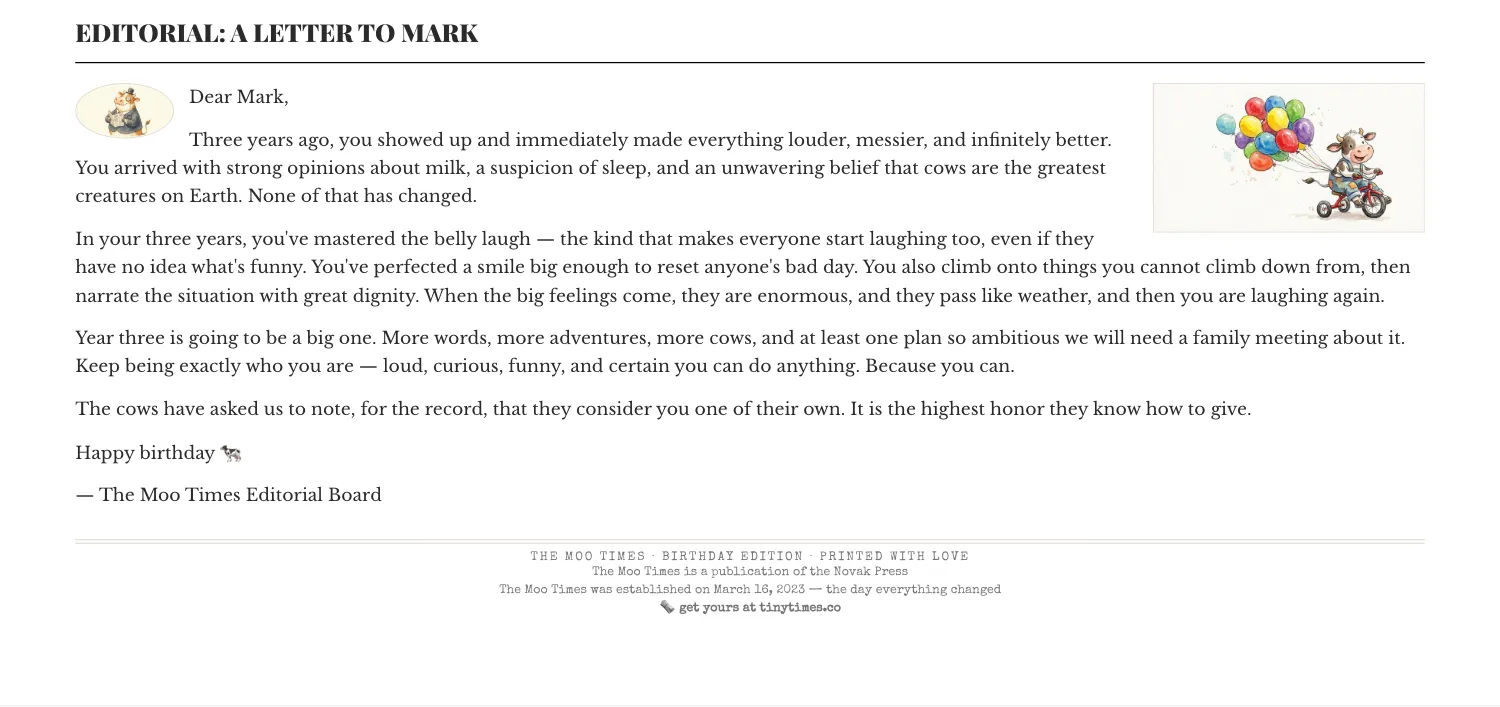
Decide how your family will use it
Frame a favorite page, put the full edition in a memory box, or read the headlines together on the birthday morning. A copy for grandparents can let them enjoy the small stories they may not hear every day.
If you display it at a party, choose a spot where adults have a moment to read it. The keepsake can go home with the birthday family afterward. The point is to save your child's story, so a large print run is usually unnecessary.
Tiny Times currently delivers a digital PDF for you to print; physical printing and shipping are not included in the digital purchase. Our printing guide explains paper size, scaling, and what to check before ordering a copy from a print shop.
Common questions
How much does a personalized birthday newspaper cost?
With Tiny Times, the preview is free: all the text, watermarked, with some illustrations in grey or held back. The keepsake edition is $19.99, which includes every illustration in full color, text editing, watermark removal, and a printable PDF. Printing is separate.
Who writes the newspaper?
AI writes the stories and makes the illustrations from the details you enter. You read a preview and, in the paid edition, can edit the text before printing.
Do I need any writing or design skills?
No. You give the details in a form and the paper is laid out for you. The only thing we ask you to do carefully is check the names and facts.
What ages does it work for?
It's written for young kids, and the form accepts ages from one up. Our samples show ages 1, 3, 7 and 10; the age-1 sample is written by hand. For a one-year-old, AI is told to write the interview answers as sounds and actions, but check that interview closely, since it can slip.