The interview at four
Birthday interview questions for a 4-year-old, the household expert
A four-year-old has theories. Ask how anything works and you will get a confident, detailed and mostly invented explanation, in full sentences. That makes four a great age for a birthday interview. These questions give them room to explain, and the printable sheet has a box for the drawing they will want to make.
Jump to the free printable ↓What a four-year-old can answer
By four, the CDC's milestone checklist includes saying sentences of four or more words, talking about at least one thing that happened during their day, and answering simple questions such as "What is a coat for?" It also lists drawing a person with three or more body parts, which is why the printable sheet saves room for a self-portrait.
What changes from three is the explaining. A three-year-old tells you what is true. A four-year-old tells you why, in steps. The best questions at this age ask how something works, what something is for or what the rules are, and then get out of the way.
How to interview a four-year-old
Treat them as the expert. Ask as if you really don't know how a sandwich gets made or why people sleep, and let them teach you. Four-year-olds love being the one who knows, and they go into far more detail for an audience that seems to need it.
Give them a role if they lose interest. Plenty of four-year-olds will keep answering as a dog, a superhero or a teacher long after they've stopped answering as themselves, and those answers are worth keeping. Write "(as a dog)" next to them.
Split it into two sittings of about eight questions, with the drawing in between. At the end, read their answers back to them. They usually add something, and they will want to approve the transcript.
16 questions for a four-year-old
Most of these invite an explanation. When an answer comes back short, ask "How do you know?"
- What can you do now that you couldn't do when you were three?
- How do you make a sandwich? Tell me every step.
- What are grown-ups for?
- What was the best part of today?
- What is one rule in our house, and who made it up?
- What do you know about your favorite thing that I don't?
- Why do people have to sleep?
- What is the silliest thing that ever happened to you?
- What would you do if you were invisible for a day?
- Who do you play with, and what's the game?
- What are you scared of, and what helps?
- What do you want to learn to do next?
- What's your favorite story, and how does it end?
- What do I do all day while you're at school?
- If you could make one new rule for the whole world, what would it be?
- What are the stars?
Line the answers up with last year's
If you asked the questions for a three-year-old last year, lay the two sheets side by side. The answers at four are longer, more certain and more often about other people. A child who answered "cows" to everything last year may now hold a cow theory in three parts.
Date the drawing and keep it with the sheet. Self-portraits at four are wonderful: arms growing out of heads, enormous shoes, a sibling who is mostly hair. Next year's questions for a five-year-old ask them to sign their own name, so their handwriting starts its own record. For questions to repeat every birthday from now on, see the main birthday interview guide.
From their theories to a front page
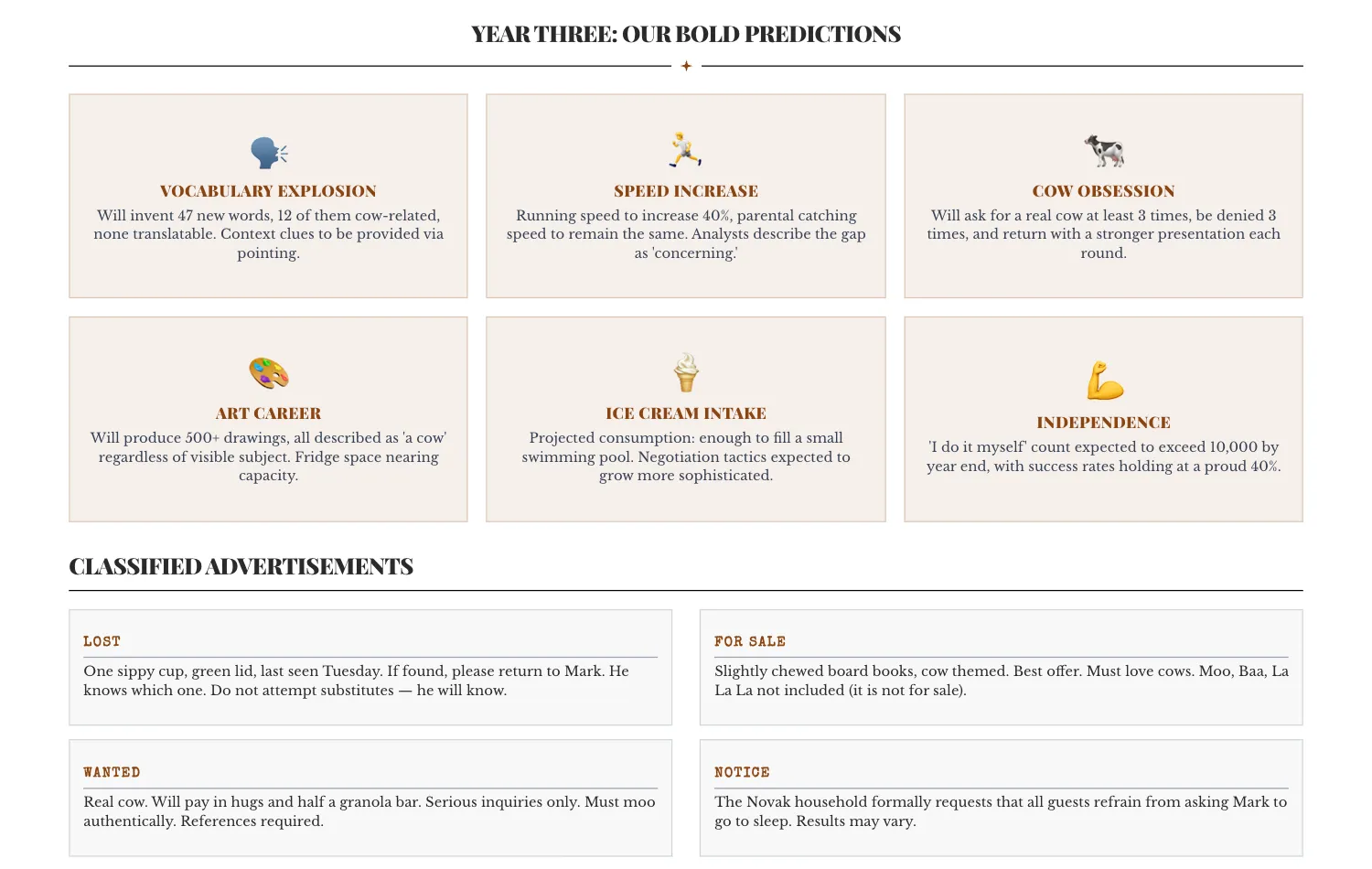
A four-year-old's theories are good material for a funny birthday newspaper. Its predictions for the year land best when each one grows out of something the child really does or believes, the way each prediction in The Moo Times, our hand-written sample, grows out of something its invented three-year-old does: his running, his drawings, his campaign for ice cream.
If you make a paper with Tiny Times, AI writes it from the details you give: a front page, an interview written in character, six predictions and a letter. Your interview sheet doesn't get printed, and the answers in the paper's interview are made up around what you shared. To get one of their real lines in, type it into "Something they said" on the form, and the paper quotes it as written. The preview is free, and $19.99 unlocks the printable PDF if you want to keep it.
Common questions
What are good birthday interview questions for a four-year-old?
Questions that let them explain: how to make a sandwich, what grown-ups are for, why people sleep, what one house rule is and who made it up. Four-year-olds love being the expert, so ask as if you don't know the answer.
How long will a four-year-old answer questions?
Longer than at three, but rarely sixteen in a row. Two sittings of about eight questions each work well, with a drawing break in between.
Why put a drawing in a birthday interview?
A dated self-portrait each year shows a change nothing else captures. Keep each one with that year's answers, and the stack of drawings becomes its own record of how they grew.