The interview at five
Birthday interview questions for a 5-year-old, now telling stories
Five-year-olds tell stories. Ask a simple question and the answer may come back with a beginning, a middle and a dramatic twist involving a dog. Many are starting school, writing a few letters and counting everything in sight. These questions are made for that, and the printable sheet saves a space for them to write their own name.
Jump to the free printable ↓What a five-year-old can answer
The CDC's milestone checklist for five includes telling a story they heard or made up with at least two events, keeping a conversation going for more than three back-and-forth exchanges, using words about time like "yesterday" and "tomorrow," and writing some letters of their name. So a five-year-old can answer a question about last week, invent a story on request and sign the sheet.
The same checklist lists paying attention for 5 to 10 minutes during an activity like story time. That makes a useful guide for the interview: ten good minutes will get you further than half an hour of trying to finish the list.
How to interview a five-year-old
Make it official. Five-year-olds like rules and roles, so announce the annual birthday interview, explain that a reporter (you) has questions, and tell them they may say "No comment" to any of them. Few use it, and the ones who do use it with great dignity.
Ask for stories. "What happened at school today?" gets "Nothing." "Tell me about the funniest thing anyone did at school this week" gets a story. If they are stuck, start one for them and let them finish it.
Hand them the pencil at the end. Let them write their name in the box on the sheet, however it comes out; letters facing the wrong way are the best kind. Then let them ask you one question back, since they have been patient.
16 questions for a five-year-old
These lean on what five-year-olds are good at: stories, time, friends, school and rules. Write the answers word for word, twists included.
- What's different about being five?
- Make up a story about a dragon. What happens first, and then what?
- What did you do yesterday, and what do you want to do tomorrow?
- What is the best part of school, and the worst?
- Tell me a joke you know. (Write it down even if it makes no sense.)
- What is the most important job a grown-up has?
- Who did you play with most this year, and what did you play?
- Where will you live when you're grown up, and who will live with you?
- If you could get rid of one rule, which would it be?
- What do you do to help at home?
- Can you think of a word that rhymes with your name?
- Do you have any wiggly teeth?
- What do you think about when you can't fall asleep?
- If you had a superpower, what would it be, and what would you use it for?
- What does love mean?
- What do you want to get better at before you turn six?
Start the handwriting record
The name box is the part of the sheet that pays off later. At five, a name may arrive in capitals of five different sizes, with one letter facing backward. Ask for it every birthday, in the same spot, and in a few years you will have a row of names that shows exactly how they grew up.
Put this sheet next to last year's, if you have it, and you will see the answers move from what things are to what happened. The questions for a four-year-old were about explaining the world, and these are about their own place in it. Next year, the questions for a six-year-old bring in fairness, money and a turn to interview you. The main birthday interview guide has questions to keep for every year.
Their stories, on a front page
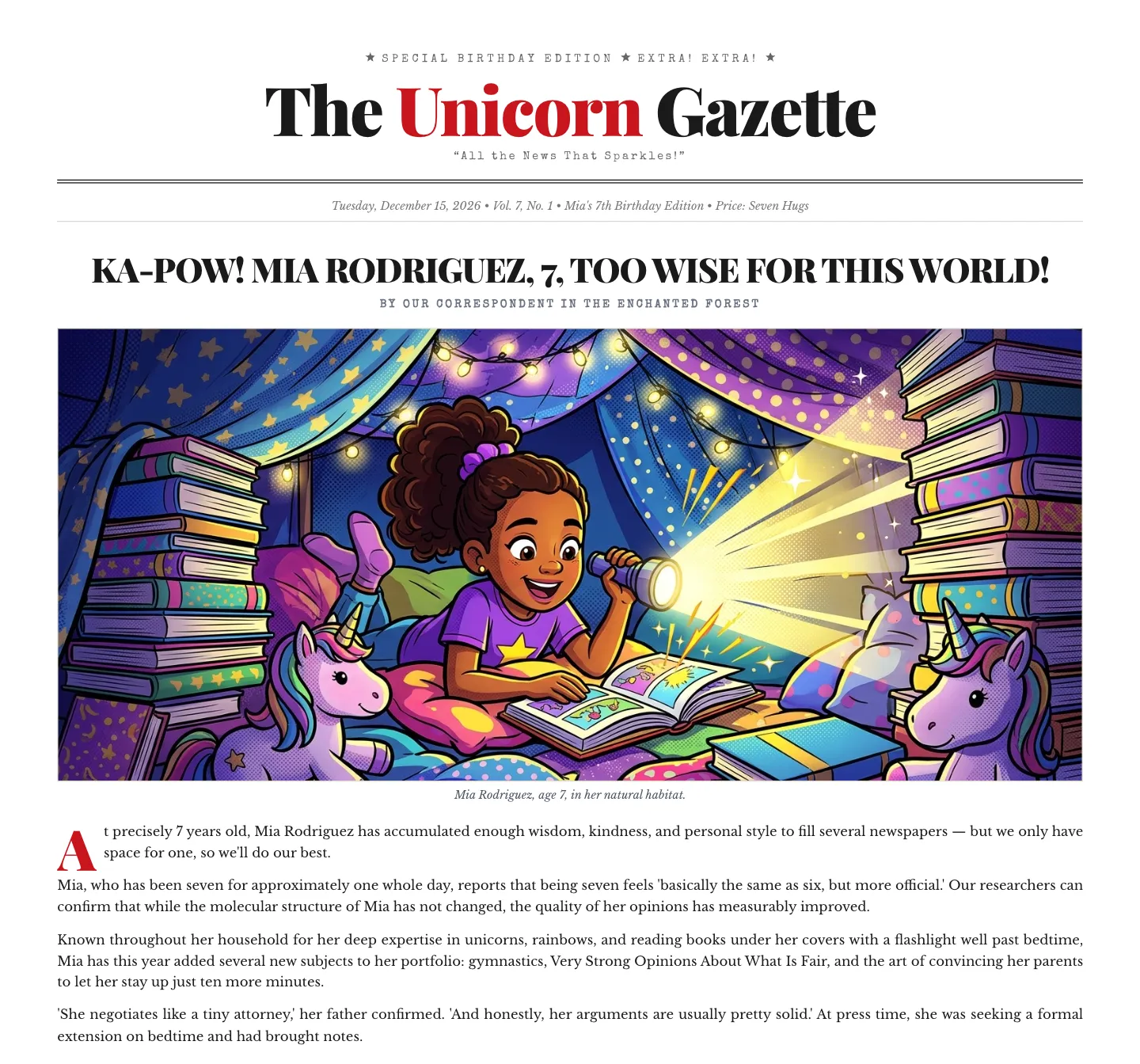
A birthday newspaper takes one thing your child is known for and runs it as front-page news. The Unicorn Gazette, a sample we wrote by hand for an invented seven-year-old, is built that way: one big interest, a loud comic-book headline and a story underneath.
If you make a paper with Tiny Times, AI writes it from the details you share, with a front page, an interview written in character, predictions and a letter. It doesn't print the sheet you filled in, and the answers in its interview are invented around what you told us. You can bring one real line across by typing it into "Something they said" on the form, where the paper quotes it as written. The preview is free, and $19.99 unlocks the printable PDF for your printer or a local print shop.
Common questions
What questions do you ask a five-year-old on their birthday?
Questions that let them tell a story or talk about time: what they did yesterday, what they want to do tomorrow, the best and worst part of school, a story they make up about a dragon, the rule they would get rid of. Then ask them to write their name on the sheet.
How long can a five-year-old focus on an interview?
The CDC's milestone checklist lists paying attention for 5 to 10 minutes during an activity like story time by age five. Plan on about that, and finish the rest another time.
Should my five-year-old write their own answers?
Let them write their name, and write the answers yourself, word for word. A few five-year-olds will want to write a word or two more, so leave them room to try.